Daniel
I'd Like to Apologize to Every Teacher I Ever HadDaniel is one of Tony Danza’s most important students at Northeast High School because his progress becomes a practical test of the teacher’s work. A varsity defensive tackle with enough academic difficulty to remain an uncertain bellwether, he is also unexpectedly imaginative and artistically talented. His year gathers around a series of revealing contrasts: the large football player who performs a tiny abandoned kitten, the student who paints grief while reciting poetry, and the reliable boy whose solid grade allows Tony to believe that the class has genuinely learned.
Identity and Introduction
Daniel first appears through the school’s broad social and physical world, where he is identified as Tony’s varsity defensive tackle. That athletic identity makes his later artistic performances especially striking. He is not reduced to the role of football player, however. Tony describes him as a good student who pays attention but sometimes struggles, making his work a useful indicator of whether the class is keeping pace. Daniel’s performance therefore carries a double significance: it reflects his own effort, and it helps Tony judge the effectiveness of his teaching.
The school itself is unusually large, with three stories, trailers, sports fields, a football stadium, a cafeteria, cavernous gyms, and a police station. Within that institutional scale, Daniel’s individual development gives the classroom a human measure. His achievement is not abstract improvement recorded from a distance; it appears in a student who can move between the identities Northeast values and those the classroom makes possible.
Participation and Unexpected Imagination
Daniel’s theatrical imagination becomes visible after spring vacation, when Tony asks students to write about something that happened during the break. While most students describe family outings or parties, Daniel volunteers to read about rescuing a soaked, hungry kitten from his backyard. As he tells the story, he cups his enormous hands beneath his chin as though holding the animal, produces a meow, and sighs after naming it Fluffy. The image is deliberately incongruous: a nearly twenty-year-old defensive tackle performs the helplessness of a tiny kitten.
The class’s response turns Daniel’s performance into a shared literary recognition. Howard compares him to Lennie with the dead mouse from Of Mice and Men, linking Daniel’s imagined tenderness to the novel’s dangerous and poignant treatment of innocence. Daniel’s story consequently does more than entertain. It shows that his physical size and athletic reputation conceal a capacity for gentleness, mimicry, and comic vulnerability, while also demonstrating how classroom reading has given students a common language for interpreting one another.
Daniel also participates in Tony’s poetry contest, an assignment requiring students to memorize a poem of at least ten lines, prepare a poster explaining its historical context and the poet’s biography, and discuss figurative language, mood, structure, and imagery. The contest is modeled on American Idol and includes a Flip Video camera and cash prizes, but Daniel’s achievement ultimately exceeds the incentive structure. He becomes one of three finalists with Sandra Tolson’s “He Sits Alone,” a poem about an old man abandoned in a nursing home to die.
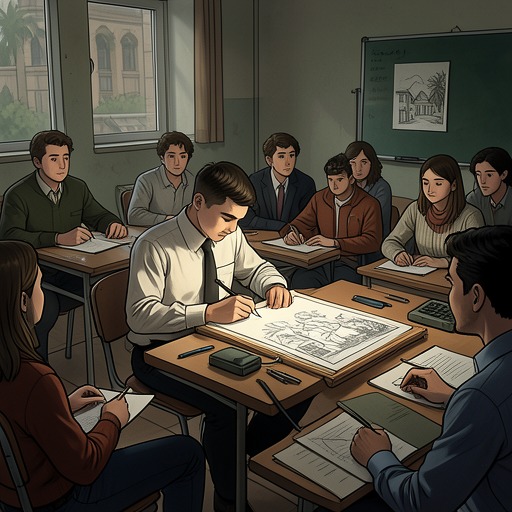
Daniel recites the poem slowly and quietly while low, sad instrumental music plays. Beside him is a colorful portrait he has painted of a bearded man weeping beside a window. His reading moves Ms. Carroll to tears, revealing a command of atmosphere that is not merely verbal. Daniel interprets the poem through voice, pacing, music, and visual art, turning a class requirement into a coordinated act of performance and empathy.
Academic Measure and Recognition
When Tony grades the final examinations, he begins with Daniel because Daniel is usually his bellwether. Tony knows that Daniel pays attention and is capable, yet sometimes struggles; if Daniel does well, Tony believes there is a good chance that the teacher has done his job. Daniel’s eleven-page test initially intensifies Tony’s fear that the exam may have been too demanding. The result resolves that uncertainty: Daniel earns a solid B, a grade Tony checks twice before allowing himself to accept it.
Daniel’s result is part of a larger success. After two hours of grading, Tony can say that no one has failed the class, while all three of his IEP students have performed better than he expected. The final essay asks students to identify the most important lesson they learned during the year. Their answers use correct essay form and echo phrases from the classroom, but Tony is most affected by the recognition that the strongest lessons were not simply taken from books. Daniel’s own contribution to this culture of participation is expressed less through a quoted maxim than through the sustained evidence of his work: he has become a student whose attention, interpretation, and artistic effort can carry the weight Tony places upon them.
Relationships and Final Conversations
By the last day, Daniel is among the students who remain in Tony’s classroom after the others have left. He proudly holds the portraits of Shakespeare and of the old man from his poetry recital. Tony tells him that he truly meant it whenever he said Daniel was talented—seriously talented. Daniel does not answer directly. Instead, he looks around the room and observes that it looks different, noticing the walls after the class’s work has been removed. His response locates the year’s emotional history in the classroom itself: the room has changed because the students’ projects, images, and shared labor have filled it and then disappeared.
Tony urges Daniel to continue working at the same level and says that he expects Daniel to make his mother proud. Daniel answers that he has no choice because she is bigger than he is, converting encouragement into a joke about family authority and preserving the affectionate informality of their relationship. The exchange shows Daniel receiving praise without becoming solemn. His humor does not cancel the seriousness of Tony’s faith in him; it gives that faith a form Daniel can comfortably accept.
Daniel also shares the final departure with Alex. The two boys help Tony load his rental car, fist-bump him, and hug him before suddenly disappearing from view. Tony feels bereft when the students are gone, and the empty school seems to have lost its purpose during the summer. At the intersection, he spots Daniel and Alex waiting to cross. Tony honks and waves, and both boys answer with radiant grins while pretending to tap-dance. Daniel’s final appearance is therefore not a formal academic triumph but a small, playful continuation of connection beyond the classroom.
Narrative Role and Significance
Daniel functions as a rounded counterpoint to the assumptions attached to athletic masculinity. The narrative repeatedly places his large body beside delicate or sorrowful forms: the rescued kitten, the abandoned old man, the painted portrait, and the quiet music of his poetry recital. These juxtapositions do not deny his identity as a football player; they enlarge it, showing how a student’s abilities become legible when a teacher creates varied ways to participate.
He is also a measure of Tony’s changing understanding of education. At first, Tony fears the test as a verdict on his own competence, and Daniel’s performance becomes the result he most urgently needs to inspect. The solid B releases Tony from that fear, but Daniel’s deeper importance lies in what cannot be reduced to a grade. His poetry, painting, humor, and willingness to remain until the end show achievement as active participation and self-expression. Through Daniel, the classroom becomes more than a place where students complete assignments: it becomes a setting in which an athlete can be recognized as an interpreter, an artist, and a person capable of making the teacher believe that the year mattered.